| South Georgia |
| The Cemeteries |
| Naming Conventions |
| Research and Information |
| Maintenence |
| Other Information |
| Website Updates |
| Links |
The Island of South Georgia lies at the Southern extreme of the South Atlantic Ocean, on the edge of the cold Southern Ocean that surrounds Antarctica. 600 miles from the nearest land, the Falkland Islands, it was the scene of remote seal and whale hunting over the past three centuries. Many died in these harsh industries and were buried on the island, far from home. The hunting has stopped but the men still lie buried here. This website is for the families and friends of these men, who may never have the opportunity to visit the graves, but who can at least see some pictures.
The main cemeteries are at the abandoned whaling stations of Leith, Stromness, Husvik, Grytviken, Prince Olav Harbour, and Ocean Harbour. There are undoubtedly unmarked graves in other sites on the island. There is also a known grave site at Godthul (rediscovered in 2006/7).
Some graves have no markers, so we do not know who is buried there. In other cases, records exist for a person, but we do not know where he is buried.
This website allows the graves to be examined in two ways, either by looking up information on a person or by looking a particular grave. To look for a particular name, select Search Names from the menu at the top of the screen. To find a particular grave, select the cemetery from the list at the top of the page, and when the page for that cemetery is displayed, select the option to explore that particular cemetery.
Graves are numbered here according to the scheme used in Headland(see below).
Much of the information here is based on a paper Antarctic Whalers Cemeteries by Bob Headland of the Scott Polar Research Institute in Cambridge, England, to whom I am very grateful. Originally published in Norwegian in the Sandefjord Museums Arbok, 1981-86 it was translated into English.
Between 1977 and 1982, Headland visited the cemeteries and subseqently researched magistrates' records, church record books, and consolidated the information found in this invaluable document.
Nigel Bonner translated some notes in the Husvik Grave book, and added some notes.
More information on some of the people was added following my visit to Sandefjord in February 2006. The very helpful folk at the Whaling Museum and Library came up with lots of Old newspaper cuttings, photographs and translating help.
The cemeteries were maintained by the whalers whilst the stations were operating. Subsequently, sporadic maintenence was undertaken by the British Antarctic Survey and the military garrisons stationed on the island. Since the early 1990s the South Georgia Museum Trust has maintained the Grytviken Cemetery.
In 1998/99 Pat and Sarah Lurcock spent the southern summer tidying up the cemeteries at Leith, Stromness and Husvik. Click here to read about that.
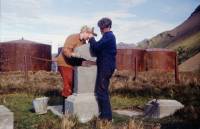
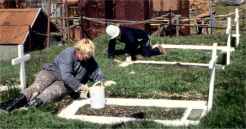
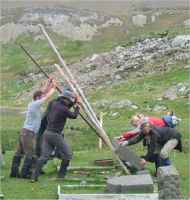
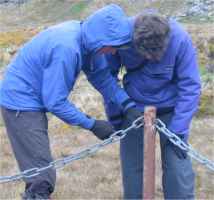
Other vistors have occasionally carried out minor maintenence. In December 2003 the BSES Expeditions team of young people re-erected some fallen headstones at Leith, and repaired fences at Leith and Husvik.
This website was written by Pat Lurcock in 2004. The background pattern is based on a photograph of the granite on one of the Stromness graves.
Any further information on the individuals would be received with interest. Please email me on cems*wildisland.gs (replace the * with a @)
All pictures ©P.M. Lurcock unless otherwise stated.
Last Update: 15 September 2010
Update History (Since 12 March 2006)(Opens new page)
For more information about South Georgia visit the website of the Government of South Georgia and the South Sandwich Islands(Opens new page)
For some interesting photographs of Leith Harbour in the 1929/30 season visit The Photographs of Svend Johannes Winsnes(Opens new page)
Jim McLaren's website(Opens new page) includes his own fairly recent pictures and Norman Jamieson's more historic photographs from South Georgia.
Sandefjord Whaling Museum (Opens new page) in Norway has much information about the history of Norway's involvement with South Georgia. The people there were extremely helpful during my visit in February 2006, when I gathered a lot of information about some of the people buried on the island.